Latin American Spanish vs Spain Spanish: Key Differences


Latin American Spanish vs Spain Spanish is a question that always comes up when people start learning the language.
The Spanish language has more than 500 million speakers across 21 countries, making it one of the most widely spoken languages in the world. With so many native Spanish speakers, variation is inevitable.
Therefore, it’s something worth considering when you start learning Spanish. Especially as online apps and courses tend to favour one form or the other, so it was a factor for me when deciding between Babbel vs Duolingo.
The contrasts are real, but they are not barriers.
A word used every day in Mexico might sound unfamiliar in Madrid. The accent in southern Spain can feel very different from what you hear in Central America. Grammar also shifts, with Spain using certain forms that Latin Americans avoid.
The good news is, whichever form you choose, people in the Spanish-speaking world will still be able to understand you. This guide will help you make sense of it all, and you will see how pronunciation, vocabulary, and grammar change across regions, and why those changes exist.
What Do We Mean by Latin American Spanish and Spain Spanish?
When people talk about Latin American Spanish, they are talking about many varieties under one broad umbrella.
There are more than a dozen countries in Latin America where Spanish is the main language, and each has its own accent, vocabulary, and local expressions. The way Spanish is spoken in Mexico is not quite the same as in Colombia, Argentina, or Costa Rica. But all referred to by native speakers as Español.
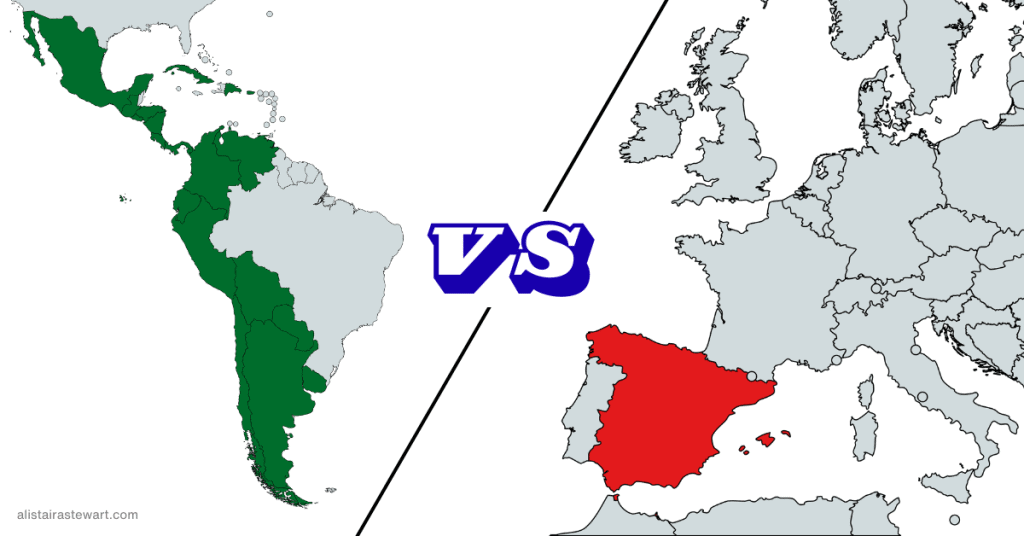
The language spoken in Spain is often referred to as Castilian Spanish (Castellano to natives) or, in academic circles, as European Spanish. This is the form taught in schools across mainland Spain and also spoken in the Canary Islands.
However, despite these differences, Spanish remains one language.
Why Are There Differences Between American Spanish and European Spanish?
When Christopher Columbus arrived in the Americas in the 16th century, the Spanish language spread across the continent. Over time, it mixed with local cultures and adapted to new settings.
The Influence of Indigenous Languages.
For example, words like chocolate and tomate come from Nahuatl in Mexico. From Quechua in the Andes, we get papa (potato). These became part of daily speech in different Latin American countries.
Other sources shaped the language, too. In Puerto Rico and Mexico, you will hear English words like rentar (to rent) or troca (truck). In Argentina, Italian immigration added rhythm and slang to the local accent. These are examples of how other languages left their mark.
I get similar questions regarding the difference between British and American English. The base is the same, but words, sounds, and grammar evolved on separate paths. Language changes when it travels and grows with the people who use it.
Both forms of Spanish still belong to the same group of Romance languages. For Latin Americans, the version of Spanish spoken in Spain can sound formal. And for people in Spain, words from Latin America sometimes feel new or surprising.
1. Pronunciation Differences
Pronunciation is where many learners first notice a clear split between people from Spain and those from Latin America. Below are the main changes to pay attention to.
The “S” vs “Z/TH” sound
In most of central and northern Spain, the letters Z and soft C (before i or e) are pronounced like the English “th” in think. This is called distinción. So gracias becomes grathias.
In Latin America, these letters are always pronounced like an “s.” This is called seseo. So gracias becomes grasias.
In southern Spain and the Canary Islands, many speakers also use seseo, which makes their speech sound closer to Latin America. In some parts of Andalusia, you may also hear ceceo, where both s and z are pronounced “th.” That means words like casa (house) and caza (hunt) sound the same.
Example:
| Word | Spain (distinción) | Latin America / seseo |
|---|---|---|
| taza (cup) | ta[th]a | ta[s]a |
| caza (hunt) | ca[th]a | ca[s]a |
The “LL” and “Y” sound
In most of Spain, ll and y sound like the English “y” in yes.
In Argentina and Uruguay, these letters change to a “sh” sound. This feature is called yeísmo rehilado.
Example:
| Sentence | Spain / Most of Latin America | Argentina / Uruguay |
|---|---|---|
| Está lloviendo en la playa (It’s raining at the beach) | Está [y]oviendo en la pla[y]a | Está [sh]oviendo en la pla[sh]a |
The letter “J”
In Spain, the J is a strong, throaty sound, similar to the German “ch” in Bach. This also applies to G before e or i (like “Gibraltar”).
In most of Latin America, the sound is softer, close to the English “h.”
Example:
| Word | Spain | Latin America |
|---|---|---|
| jamón | strong, throaty [χ]amón | soft, breathy [h]amón |
| Jorge | [χ]or[χ]e | [h]or[h]e |
Dropping or softening the “S”
In Caribbean Spanish, as well as southern Spain and the Canary Islands, the s at the end of syllables often disappears or turns into a soft breath. This is called aspiration or elision.
Examples:
| Sentence | Standard pronunciation | Caribbean / Andalusia / Canaries |
|---|---|---|
| Estás aquí | Es-tás a-kí | Eh-táh a-kí |
| Las cosas | Las co-sas | Lah co-sah |
What this means for learners
These differences may seem big at first, but they are not major problems. You will be understood across the Spanish-speaking world, no matter which version you use.
It’s the same with any language and not just between continents. When I lived in Malaga, I had the same issue between the ‘malagueño’ (from Malaga) and ‘madrileño’ (from Madrid) accents.
However, it was for this reason that I took online classes with teachers from other Spanish-speaking countries when I started studying Spanish. It provided me with exposure to these differences in pronunciation early on, which helped improve my comprehension. TV series or podcasts can do the same.
My recommendation for learning Latin American Spanish is to use Rocket Spanish, as it is what they teach and use for listening practice. But for Spain Spanish, try Mondly.
2. Vocabulary Differences
The main differences in vocabulary show up in everyday objects and food. A word that feels normal in one country can sound strange or even funny in another.
Common objects
Here are some of the most frequent changes learners notice:
| English | Spain | Latin America | Notes |
|---|---|---|---|
| Car | coche | carro / auto | Carro is common in Colombia. Auto is frequent in Argentina and Chile. |
| Computer | ordenador | computadora | Ordenador is standard in Spain, while computadora is used across Latin American countries. |
| Cell phone | móvil | celular | Celular is also common in Puerto Rico and El Salvador. |
Food and drink
Even simple items like “juice” vary:
| English | Spain | Latin America |
|---|---|---|
| Orange juice | zumo de naranja | jugo de naranja |
In Venezuelan and Colombian Spanish, “arepa” refers to the corn flatbread eaten daily. In Spain, the same word is not used (unless referring to the Venezuelan or Colombian food).
Day-to-day terms
Many small things in day-to-day life also shift.
| English | Spain | Latin America |
|---|---|---|
| Bus | autobús | camión (Mexico), colectivo (Argentina) |
| Pen | bolígrafo | pluma (Mexico), lapicera (Argentina) |
| Money (slang) | pasta | plata |
What this means for learners
This was the biggest difference I noticed when using Duolingo, which uses vocabulary from Latin America. Some of my answers that used words from Spain were marked as incorrect, which was frustrating.
For this reason, as I already mentioned, I found the exercises on Mondly much more useful and suited to my needs.
But it’s no different from saying ‘sidewalk‘ in the USA and ‘pavement‘ in the UK. In fact, there are vocabulary differences between cities and regions of the UK.
Again, there’s no right or wrong, and it’s always useful to know these different words, regardless of where you use Spanish.
3. Variations in Grammar and Tense
One major difference between Spanish-speaking countries is how people use plural forms.
In Spain, people often use vosotros to address a group in informal situations. However, in Latin America, the plural is always ustedes, even when speaking with friends.
Example:
- Spain: ¿Vosotros queréis comer ahora? (Do you all want to eat now?)
- Latin America: ¿Ustedes quieren comer ahora?
In Argentina, Uruguay, and parts of Central America, you will also hear vos instead of tú. This is called voseo. The verb endings change as well.
Example:
- Tú hablas (you speak) → Vos hablás
- Tú tienes (you have) → Vos tenés
Past tenses show another main difference. In Spain, people often use the present perfect to describe recent actions. In Latin America, the simple past is more common.
Example:
- Spain: He comido hoy (I have eaten today).
- Latin America: Comí hoy (I ate today).
These are the most important differences that learners will notice in grammar.
4. Formal and Informal Address
How you address people also varies between Spanish-speaking countries.
In Spain, most people often use tú with friends and usted in more formal situations. But in much of Latin America, the balance is different. Usted is used more often, even among younger people, as a sign of respect.
This is something I still struggle with at times, and I find myself unsure of the form to use if the person is not from Spain.
In the Southern Cone countries, such as Argentina and Uruguay, vos takes over the informal role. It is the standard way to talk to friends or family, while usted stays formal.
Examples:
- Spain (informal): Tú eres muy simpático.
- Colombia (formal tone, but still common): Usted es muy simpático.
- Argentina (informal): Vos sos muy simpático.
This reflects social habits as much as grammar rules. Choosing between them is more about politeness and cultural fit than strict grammar.
5. Idioms, Phrases, and Slang
Each region has its own words and common phrases that give the language a local flavour. Even simple greetings vary between countries. You can see a more detailed look at this in my Hi in Spanish post.
In Spain, you often hear “vale” used to mean “okay.” In Mexico, people are more likely to say sale or ándale.
In Argentina, the word che is used at the start of sentences, much like “hey” in English. In Colombia, parce or parcero is a popular way to say “buddy.” In Puerto Rico, you’ll often hear pana among friends.
These are different words with their own cultural meaning and tone. So understanding phrases like this in Spanish can help you grasp the regional style.
Regional Differences Within Latin America
Latin America is not one single accent. Each Latin American accent has its own style, shaped by history and local culture.
Central American accents tend to be softer and clearer. Countries like Costa Rica and El Salvador tend to use straightforward grammar and vocabulary, which many learners find easier to follow.
In South America, the variety is greater. The southern cone has a strong Italian influence, visible in intonation and the use of “vos.” The famous sh sound for ll and y is a clear marker of the region.
Northern areas like Mexico and Colombia stand out for different reasons. Mexico City Spanish is often considered a standard reference for media and education. Colombian Spanish, particularly from Bogotá, is well known for its clear pronunciation and neutral tone.
These subtle nuances show how the Spanish language changes across Latin American countries, giving each group of Latin Americans its own voice within the wider Spanish-speaking world.
Which Variant Should You Learn?
The best choice depends on your goals. If you want to work or study in Spain, learning Spain Spanish makes sense. If your focus is travel, business, or family ties in Latin America, then that is the variety to target.
Media can guide your decision. Many popular films, TV shows, and songs come from Mexico, Colombia, and Argentina. On the other hand, if you prefer to follow European news or Spanish cinema, then Castellano might be a better fit.
Professional needs also matter. Some international companies use Spain as their base, while others operate across many countries in the Americas.
Matching your learning to your career path is a smart move.
Conclusion
The differences between Latin American Spanish vs Spain Spanish can be seen in pronunciation, vocabulary, grammar, and culture.
It is the native language for more than 500 million people worldwide, and the official language in 21 countries, so there are always going to be differences. From the “s” vs “th” sound to words like zumo and jugo, each region leaves its mark on the Spanish language.
As a Spanish learner, the best choice is the one that matches your personal goals. Language courses, apps, and online resources are available for both Spain and Latin America, so pick the path that suits you.y of speakers and opening the door to a new way of experiencing the world.
FAQ
What is the main difference between Latin American Spanish and Spain Spanish?
The biggest changes are in pronunciation, vocabulary, and some grammar. For example, Spain uses vosotros, while Latin America uses ustedes.
Which Spanish is easier to learn for beginners?
Many learners find Latin American Spanish a bit clearer to follow, but both are fine. The best choice depends on where you plan to travel, work, or study.
Will I be understood if I learn only one variant?
Yes. Spanish is one language, and native speakers across regions will understand you, even if some words or accents differ.
Why does Spain use “vosotros” while Latin America doesn’t?
Over time, Spain kept the informal plural form vosotros, while Latin America shifted to ustedes for all groups. Both are correct and widely used.
Should I learn Castilian Spanish or Latin American Spanish?
Match your choice to your goals. If you’ll travel or work in Spain, go for Castilian. If your focus is Latin America, study that variety. Both open doors.